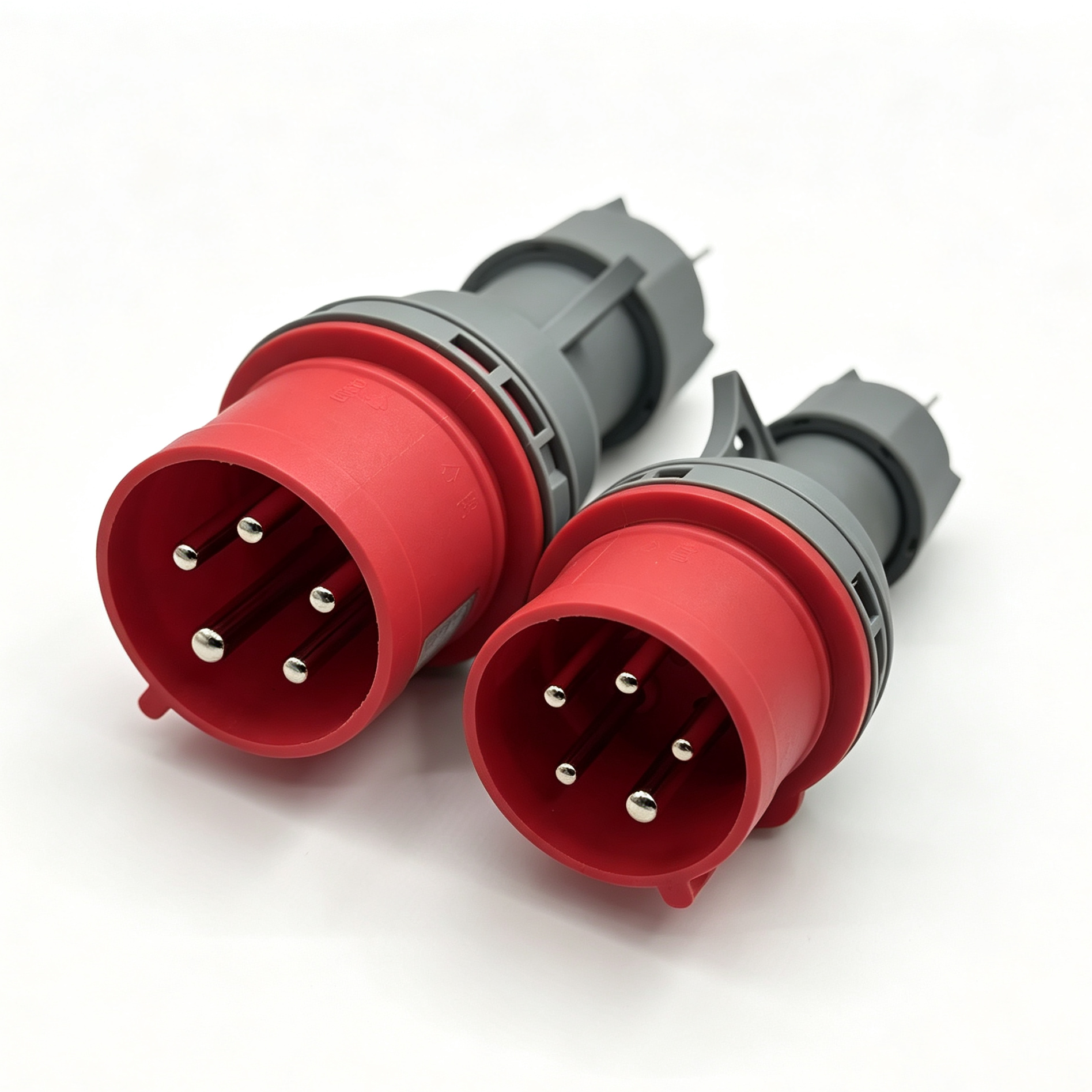
IEC 60309 is the international standard system for industrial plugs and sockets, originating in the 20 century during the 60s. It has evolved through multiple revisions to its current form. This article covers its development history, standard composition, dimensional compatibility, and core technical requirements.
What is an industrial socket conforming to IEC 60309 standards? Learn about the origin and specifications of IEC 60309.
In the field of industrial electrical connections, IEC 60309 is a frequently cited standard. Many industrial plugs, sockets, and connectors are marked with IEC 60309.
However, IEC 60309 is not simply an "industrial socket product standard."
It is actually a set ofIndustrial plugs, fixed or mobile sockets, appliance inlet connectors, and related couplersThe international standard system aims to enhance the safety and reliability of industrial power connections through unified electrical and mechanical requirements, while reducing the risk of incorrect connections between products of different specifications.
So, how was IEC 60309 developed? What specific requirements does it outline? And why are IEC 60309 standards now widely adopted for industrial plugs and sockets?
1. How was the IEC 60309 standard developed?
Industrial production growth has created a very practical problem:
Industrial plugs and sockets manufactured by different companies in various countries may differ in structure, dimensions, electrical parameters, and connection methods.
Without unified technical requirements, the following issues may arise:
Products from different manufacturers cannot be properly matched.
Different voltage level products may be incorrectly connected.
Non-standardized mechanical dimensions for plugs and sockets.
Inconsistent safety requirements for electrical connections.
Industrial equipment replacement and maintenance are more challenging.
Therefore, industrial electrical connection products require a more unified international technical standard.
IEC (International Electrotechnical Commission) develops international standards for electrical, electronic, and related technologies.
The earliest standard version of IEC 60309 dates back to1969Subsequently, the standard underwent continuous revisions and improvements. According to IEC official records, IEC 60309-1 was first published in 1979, followed by updates in 1988, 1997, and 1999.
The fourth edition of 1999 became the key standard for long-term use and was revised in 2005 and 2012. In 2021, IEC published the new fifth editions IEC 60309-1 and IEC 60309-2, which incorporated technical revisions to the original requirements.
Therefore, IEC 60309 is not a standard that has emerged only in recent years; it is an industrial electrical connection standards system that has undergone long-term development and continuous revision.
2. What exactly does IEC 60309 specify?
Many people see IEC 60309 and simply think:
IEC 60309 is the standard for industrial sockets.
This understanding is incomplete.
IEC 60309 actually covers various electrical connection products for industrial use, including:
Industrial Plug
Fixed Socket
Portable power strip
Appliance Input Socket
Related connectors and couplers
IEC 60309-1 ResponsibleGeneral Requirements, while IEC 60309-2 is primarily responsible forDimensional compatibility requirements for plugs, sockets, and similar productsCurrently, IEC officially uses these two parts as complementary standards.
Additionally, IEC 60309 includes other relevant parts. For instance, IEC 60309-4 specifies products such as industrial sockets with switch functions. According to data from the IEC technical committee, the IEC 60309 series has established a comprehensive standard system for industrial connection products.
Therefore, more accurately:
IEC 60309 is a series of international standards for industrial power connection products, not just a single standard for industrial sockets.
3. What are the main provisions of IEC 60309-1?
The name of IEC 60309-1 is:
Industrial plugs, fixed or portable socket-outlets, and appliance inlets – Part 1: General requirements
That is:
Plugs, socket-outlets and appliance couplers for industrial use — Part 1: General requirements.
It primarily establishes the general technical requirements that industrial plugs, sockets, and related products must meet.
The current IEC 60309-1:2021 applies to rated operating voltages not exceeding1000V AC or 1000V DCProducts with a frequency not exceeding 500 Hz, rated current not exceeding 800 A, and primarily intended for industrial use.
Compared to earlier versions, the 2021 edition of the 5th version has further advanced its scope of application and technical requirements.
For example, the scope of the 1979 edition is rated voltage not exceeding 690V and rated current not exceeding 250A.
This also shows that IEC 60309 is not a static standard, but evolves continuously with advancements in industrial equipment and electrical connection technologies.
4. What are the main provisions of IEC 60309-2?
If IEC 60309-1 addresses:
What general requirements should industrial plugs and sockets meet?
Thus, IEC 60309-2 focuses more on:
How should the dimensions and connection structures of these plugs and sockets be designed to ensure compatibility?
The official name of IEC 60309-2 is:
Plugs, fixed or portable socket-outlets, and appliance inlets for industrial use – Part 2: Dimensional compatibility requirements for pin and contact-tube accessories
That is:
Industrial plugs, socket-outlets and appliance couplers — Part 2: Dimensions of accessories for pins and contact tubes.
This section is critical because industrial plugs and sockets must not only meet electrical requirements but also ensure proper mechanical compatibility.
According to IEC official documentation, IEC 60309-2 Edition 5, Year 2021, primarily addresses dimensional compatibility requirements for pins and contact tubes and must be used in conjunction with IEC 60309-1:2021.
Therefore, the pin positions, socket structures, and mechanical compatibility across different specifications observed in industrial plugs and sockets are not arbitrarily designed by manufacturers but are governed by standardized dimensions and structural requirements.
5. Why does IEC 60309 specify "dimensional compatibility"?
A key requirement for industrial plugs and sockets, compared to standard household ones, is:
Prevent accidental connection of products with different electrical specifications.
For instance, if a device requires specific voltage and current, allowing users to easily insert an incompatible plug into an outlet can create serious electrical safety hazards.
Therefore, standardizing industrial plugs and sockets is not just about "being able to plug them in"; it's more importantly:
Correct products should match, while incorrect ones should be as difficult to match as possible.
This is also one of the key values of the IEC 60309 series standards.
6. What do the colors and structures in IEC 60309 signify?
Many users notice that industrial plugs and sockets vary in shell color when they first encounter them.
This color choice isn't just about product aesthetics.
In the IEC 60309 system, product colors identify corresponding rated voltage ranges to help users quickly distinguish between different specifications.
But color is just one way to identify product specifications.
Actual product selection still requires confirmation of:
Rated Voltage
Rated Current
Extremum
Frequency
Ground and Neutral Configuration
Clock Position
Product ID
Therefore, the complete electrical specifications of an IEC industrial connector cannot be determined by color alone.
7. What is the "Clock Position" in IEC 60309?
Clock PositionThis is a distinctive design feature of the IEC 60309 industrial plug and socket.
Simply put, you can think of the grounding contact position on an industrial socket as a clock hand's position.
Different grounding contact positions may apply to different voltages, frequencies, or electrical configurations.
This ensures that plugs and sockets with different electrical specifications have distinct mechanical structures, reducing the risk of incorrect connections.
Therefore, the "clock position" of IEC 60309 industrial plugs and sockets is not merely decorative; it is a critical anti-misplug mechanism in industrial connection systems.
When procuring, if the customer specifies an IEC 60309 product model or rating, verify the current and voltage ratings, along with the corresponding number of poles and clock position.
8. What is the significance of IEC 60309 for safety?
Industrial plugs and sockets are typically used in factories, machinery, construction sites, and other professional environments.
Therefore, IEC 60309 standards address not only whether a product can conduct electricity properly, but also its overall safety and reliability requirements.
Standardization can benefit industrial power connections in multiple ways:
1. Unified product structure
Standardize dimensions and interface requirements to improve compatibility among products with the same specifications.
2. Reduce risk of accidental connections
Different mechanical structures, pole counts, and clock positions are designed to prevent incorrect connections across varying product specifications.
3. Electrical performance specifications
Standardize the product's rated current, voltage, and related test requirements.
4. Improve product reliability
Industrial products must withstand more demanding conditions than typical household environments, so standards specify corresponding mechanical and electrical performance requirements.
9. How has the IEC 60309 standard evolved?
From a historical perspective, IEC 60309 has undergone multiple version updates.
Time | Development |
|---|---|
1969 | IEC 60309 first edition released |
1979 | IEC 60309-1 First Edition Published |
1988 | IEC 60309-1 Second Edition Published |
1997 | IEC 60309-1 Third Edition Released |
1999 | IEC 60309-1 Fourth Edition Published |
2005 | Revise the fourth edition |
2012 | Revise again |
2021 | IEC 60309-1 and IEC 60309-2 release fifth edition |
The version information above is from IEC official publication records.
It is worth noting that2021 is not a minor tweak of a few parameters; it's a technical overhaul.。
For example, IEC 60309-1:2021 adds classifications, requirements, and tests for accessories with shutters, as well as marking requirements to identify neutral and grounding terminals.
IEC 60309-2:2021 adds requirements and tests for non-solid pins, as well as content related to IPX9.
These changes indicate that the IEC 60309 standard is continuously updated to keep pace with the development of industrial electrical products.
10. What is the current version of IEC 60309?
Key foundational standards currently in the industrial plug and socket sector include:
IEC 60309-1:2021
Covers general requirements for industrial plugs, fixed or portable socket-outlets, and appliance inlet sockets.
IEC 60309-2:2021
Responsible for dimensional compatibility requirements of pin and contact tube accessories.
Please note that IEC 60309-2 also released a new errata (COR1:2026) in 2026, Month 8. For product certification, testing, or export projects, always refer to the latest valid IEC official documents and applicable requirements of the target market.
11. Is IEC 60309 a standard that all industrial sockets worldwide must comply with?
Not necessarily.
IEC 60309 is an international standard widely used in industrial electrical connections worldwide, but individual countries and regions may also have their own national standards, certification systems, and regulatory requirements.
Therefore, for manufacturers and purchasers of industrial plugs and sockets:
IEC 60309 compliance does not automatically satisfy all regulatory requirements in every country.
If the product is intended for export, you must also verify compliance with:
Product Standards
Security Authentication
Electrical Code
Test requirements
Market Access Requirements
This is especially critical for export-oriented industrial plug and socket products.
12. What is the significance of IEC 60309 for the industrial socket industry?
The greatest significance of IEC 60309 is not to dictate "what an industrial socket should look like," but to establish a relatively unified set of standards through international norms.Electrical Parameters, Mechanical Dimensions, Interface Structure, and Safety Requirements。
For manufacturers, standards help establish consistent product design and testing criteria.
Standardization enables buyers to select products based on current, voltage, number of poles, structure, and application environment.
For industrial equipment manufacturers, standardized plugs and sockets reduce uncertainty in power interface design and maintenance.
Therefore, IEC 60309 actually establishes a more standardized industrial power connection system.
Summary
IEC 60309 is a set of international industrial power connection standards, not merely an "industrial socket standard."
Since its earliest version in 1969, IEC 60309 has evolved over decades through numerous revisions, now forming a comprehensive standards system that includes IEC 60309-1, IEC 60309-2, and more.
where:
IEC 60309-1Covers general requirements for industrial plugs, fixed or portable sockets, and similar products.
IEC 60309-2Focus primarily on dimensional compatibility for pin and contact tube products.
Design features such as color coding, pole count, connector structure, and clock positions work together to enable standardized connections for industrial plugs and sockets while minimizing the risk of misconnection.
For manufacturers and buyers of industrial plugs and sockets, as well as equipment manufacturers, understanding the IEC 60309 standard system is essential for correctly selecting and designing industrial power connection products.
If industrial plugs and sockets are intended for international trade, verify the latest standard versions, certifications, and regulatory requirements specific to the target market.
Wenzhou Keben Electrical Appliance FactoryWe offer industrial sockets in various specifications. Contact us for inquiries and purchases.