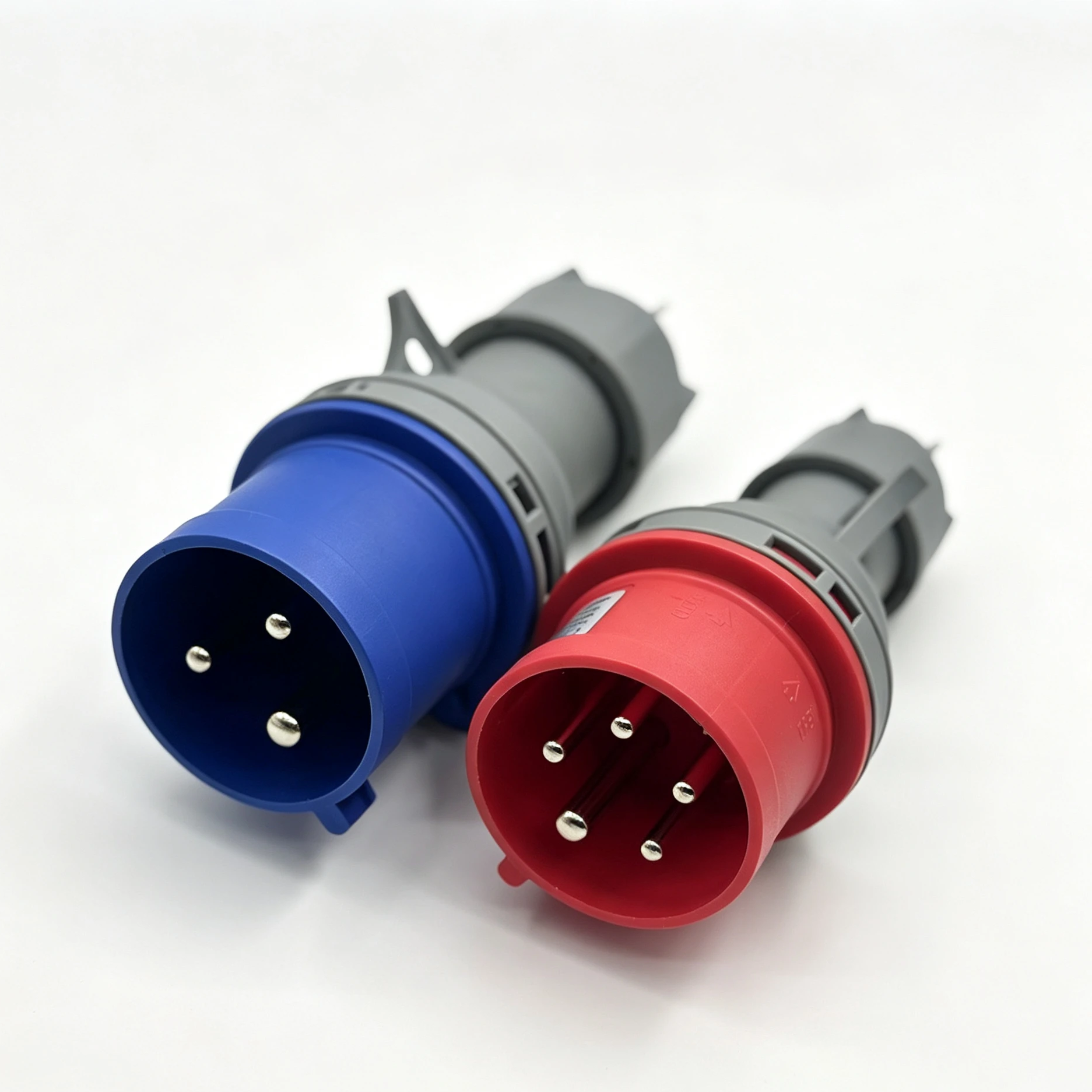
The main differences between 3-pin, 4-pin, and 5-pin industrial plugs and sockets lie in the number of power conductors and wiring methods. This guide outlines the circuit configurations and application scenarios for each specification to help users select the right industrial plug and socket.
What is the difference between 3-pin, 4-pin, and 5-pin industrial plugs and sockets?
When selecting industrial plugs and sockets, in addition to rated currents like 16A, 32A, and 63A, you will often see specifications such as 3-pin, 4-pin, and 5-pin.
So, what's the difference between the 3-pin, 4-pin, and 5-pin industrial plugs and sockets? Which scenarios are each pin count best suited for?
Actually,The number of cores is primarily determined by the quantity and wiring configuration of the power lines.Selection depends on whether the device uses single-phase or three-phase power, and whether a neutral wire and protective earth are required.
What does "core" mean in the context of industrial plugs and sockets?
The term "core" here can be simply understood as the internal component of a plug or socket.Number of electrical contacts。
Different core counts support varying numbers of power lines.
Common industrial plugs and sockets include:
3-core
4-core
5-core
Please note thatNumber of cores does not equal number of phases.。
For example, a three-phase power supply does not necessarily have only 3 conductors. In addition to the three phase wires, a protective grounding wire may also be required, and sometimes even a neutral wire is needed.
Therefore, when selecting industrial plugs and sockets, do not simply assume:
Three-phase power = 3 conductors
and must be determined based on the actual electrical system.
II. What is a 3-core industrial plug and socket?
3-pin industrial plugs and sockets are typically used forSingle-phase powerConnect.
Common wiring configurations include:
L + N + PE
That is:
L: Live wire
N: Neutral
PE: Protective Earth
Therefore, the 3-pin industrial plug and socket can simultaneously provide single-phase power and protective grounding.
Common applications include:
Single-phase industrial equipment
Small generator
Power tools
Construction Equipment
Portable Power Bank
Temporary power supply equipment
For example, some single-phase 220V devices may use a 3-core industrial plug or socket.
3. What is a 4-core industrial plug and socket?
4-pin industrial plugs and sockets are typically used forThree-phase power, no neutral wire requiredof the device.
Common configurations include:
L1 + L2 + L3 + PE
where:
L1: Phase 1
L2: Second Phase
L3: Third Phase
PE: Protective Earth
This configuration provides three-phase power with protective grounding.
Commonly found in:
Three-phase motor
Industrial Machinery
Water Pump
Air compressor
Engineering Equipment
Partial generator equipment
If the device requires only three-phase power and no neutral, a 4-core industrial plug and socket may be more suitable.
4. What is a 5-pin industrial plug and socket?
5-pin industrial plugs and sockets are typically used forThree-phase power supply; both neutral and protective ground are required.of the device.
Common configurations include:
L1 + L2 + L3 + N + PE
That is:
L1: Phase 1
L2: Second Phase
L3: Third Phase
N: Neutral
PE: Protective Earth
This connection method provides both three-phase and single-phase power simultaneously.
Therefore, in equipment that requires both three-phase operation and single-phase control circuits or other single-phase loads, 5-pin industrial plugs and sockets are commonly used.
For example:
Industrial Equipment
Switchgear
Heavy Machinery
Three-phase generator
Factory Equipment
Construction Equipment
5. What is the difference between 3-core, 4-core, and 5-core?
Simply put:
Cores | Common Line Configurations | Common Use Cases |
|---|---|---|
3-core | L + N + PE | Single-phase device |
4-core | L1 + L2 + L3 + PE | Three-phase equipment, no neutral wire required. |
5-core | L1 + L2 + L3 + N + PE | Three-phase equipment, requires neutral wire. |
By number of lines:
3-core = Single-phase + Ground
4-core = 3-phase + ground
5 conductors = 3-phase + neutral + ground
Here are the basic differences between 3-pin, 4-pin, and 5-pin industrial plugs and sockets.
6. Why do three-phase equipment sometimes use 4 cores and other times 5?
This is a common point of confusion when selecting industrial plugs and sockets.
"Three-phase" refers only to the presence of three phase wires:
L1, L2, L3
Whether the device requires a neutral wire (N) depends on its own electrical design.
If the device requires only three-phase power and needs protective grounding:
L1 + L2 + L3 + PE = 4 conductors
If the device requires a neutral wire in addition to three-phase power:
L1 + L2 + L3 + N + PE = 5 cores
So:
Three-phase equipment does not necessarily require 5 conductors; the key factor is whether a neutral wire is needed.
7. What does PE stand for in industrial plugs and sockets?
PE represents:
Protective Earth (PE), grounding wire.
It is primarily used for equipment grounding.
In the event of insulation faults or other anomalies, protective grounding provides a dedicated path for fault current and works with protection devices to reduce the risk of electric shock.
Therefore, when selecting industrial plugs and sockets, do not arbitrarily omit the protective earth conductor just to save a single wire.
PE and N serve different purposes and cannot simply replace each other.
8. How do I choose between 3-core, 4-core, and 5-core options?
When making a selection, refer to the device's power system.
If the device uses single-phase power
Common considerations:
3-Pin Industrial Plug/Socket
Common Routes:
L + N + PE
If the device uses three-phase power, a neutral wire is not required.
Common considerations:
4-Pin Industrial Plug/Socket
Common Routes:
L1 + L2 + L3 + PE
If the device requires a three-phase power supply, it also needs a neutral wire.
Common considerations:
5-Pin Industrial Plug/Socket
Common Routes:
L1 + L2 + L3 + N + PE
However, the final specifications shall be based on the electrical wiring requirements provided by the device manufacturer.
9. Don't rely solely on the device name when selecting the number of cores.
For example, seeing the term "generator" alone does not determine whether to select a 4-pin or 5-pin industrial socket.
Additional confirmation required:
Is the generator output single-phase or three-phase?
Does it require a neutral wire?
Device wiring method;
Rated Voltage;
Rated current;
Industrial plug and socket interface specifications.
Even though they are all three-phase generators, different equipment may have varying power output configurations.
Therefore,Select the correct industrial plug and socket based on the actual electrical system and equipment wiring requirements.
Can 3-core, 4-core, and 5-core cables be used interchangeably?
Generally, no.
Industrial plugs and industrial sockets are required forNumber of cores, rated voltage, rated current, and interface structureand other aspects match accordingly.
For example:
3-core products are intended for single-phase circuits only. Do not substitute them for three-phase equipment requiring 5 cores simply because their physical dimensions are similar.
Similarly, 4-core and 5-core products cannot be simply interchanged.
Incorrect selection may cause the device to malfunction or pose electrical safety risks.
Summary
In industrial plugs and sockets, the main difference between 3-pin, 4-pin, and 5-pin models lies inDifferent numbers of power lines and wiring methods。
3-core: L + N + PE, commonly used for single-phase equipment;
4-Core: L1 + L2 + L3 + PE, commonly used for three-phase equipment that does not require a neutral wire.
5 Core: L1 + L2 + L3 + N + PE; commonly used for three-phase equipment requiring a neutral line.
Therefore, when selecting industrial plugs and sockets, do not rely solely on the equipment name or number of cores; instead, considerPower Type, Wiring Method, Rated Voltage, Rated CurrentMatch.
Wenzhou Keben Electrical Appliance FactoryWe offer industrial sockets in various specifications. Contact us for inquiries and purchases.